

On December 9, 2019, New Zealand's White Island erupted .claiming 22 lives and leaving survivors with injuries that will follow them for the rest of their days.
What began as a routine tourist adventure to the country’s most active volcano turned within seconds into a desperate race for survival, as visitors and guides were swallowed by searing ash, scalding steam, and toxic gases. The world watched in horror.
Time has not softened the tragedy of White Island, nor has the legal system provided the closure many hoped would come.
In early 2025, a High Court ruling overturned a key conviction linked to the disaster - another twist in a story that never seems to settle.
So let us revisit that terrible day… and then look at what has happened since.
White Island, also known as Whakaari in Maori, is an active volcano situated about 48 kilometres off the eastern coast of New Zealand's North Island. It is a popular tourist destination, That attracted visitors with its otherworldly landscapes.
I spent my teenage years in this region, growing up in the Bay of Plenty on the Volcanic Plateau. New Zealand is known as the Shaky Isles for a reason.
It was a fairly common event to have a bit of rough and rumble while at school and we would just pop under our desks and wait until it was over before getting up and sitting down and starting the lesson again. It was no big deal really.
We lived in Rotorua, home of boiling mud pools, steam coming out of the drain systems and the smell of sulphur in the air. It was home and perfectly natural to us.
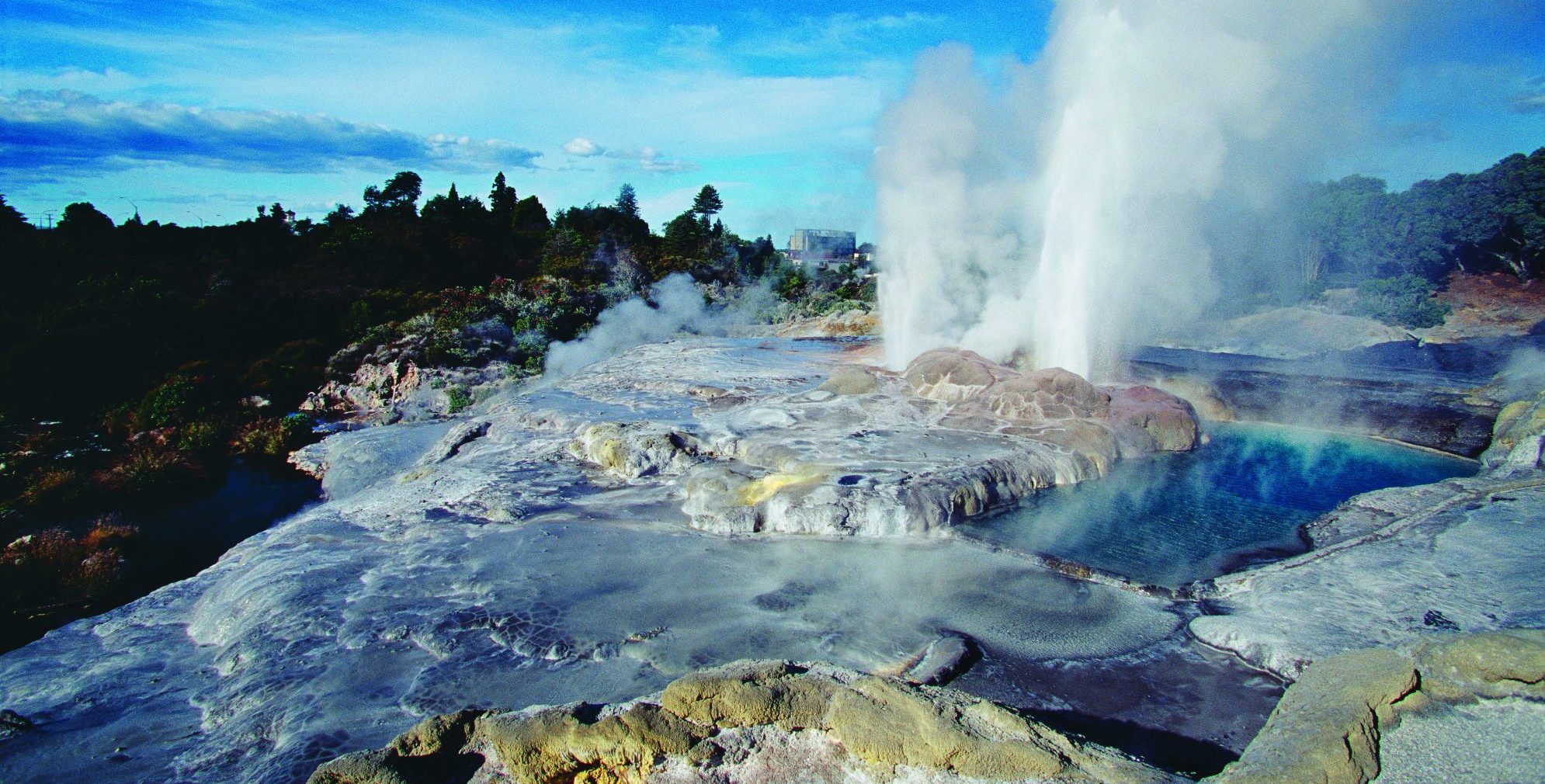
Dunkirk was about 34 km from Britain. White Island? 48 km from the coat.Twenty-two people died, including two whose bodies were never found. A further 25 people suffered injuries, with the majority needing intensive care for severe burns... but what haunted me as much as the deaths was the fact that ordinary boaties and pilots - not the state - did most of the rescuing.
 On December 9, 2019, at approximately 2:11 PM local time, White Island explosively erupted. At the time, 47 people, including tourists and tour guides, were on the island. The eruption sent plumes of ash and steam into the air, and reports suggested that rocks and debris were thrown across the crater.
White Island is classified as an active stratovolcano, and while it has a history of volcanic activity, the eruption in 2019 caught many by surprise due to its sudden and explosive nature. The island had been showing signs of increased volcanic activity in the weeks leading up to the eruption, with heightened levels of volcanic tremors and the release of sulfur dioxide gas.
The island is privately owned by the Buttle family trust. It was bought by George Raymond Buttle, a stockbroker, in 1936. Buttle later refused to sell it to the government, but agreed in 1952 that it be declared a private scenic reserve. In 2012, the island's title was transferred to the Whakaari Trust, whose shareholders are Peter, Andrew and James Buttle.
Despite the warning signs, the island remained open to tourists on the day of the eruption. The tragic incident prompted questions about the adequacy of risk assessments and safety protocols for tourist activities in volcanic zones.
The day before, on 8 December the instruments that measure tremors in nanometres momentarily spiked 30 per cent higher than any tremor during the previous two months. Or perhaps for a moment during a video shot by tourist Allessandro Kauffmann earlier in the afternoon. Kauffmann was part of the group aboard Phoenix, a White Island Tours vessel, and he videoed much of the island tour. At about 1.30pm, he panned along the hot, strangely bright stream flowing from the crater lake. Amid the snap and spit of boiling mineral water, the microphone caught an off-camera aside by a White Island Tours guide: “I’m a little bit worried why it’s going green.”
\
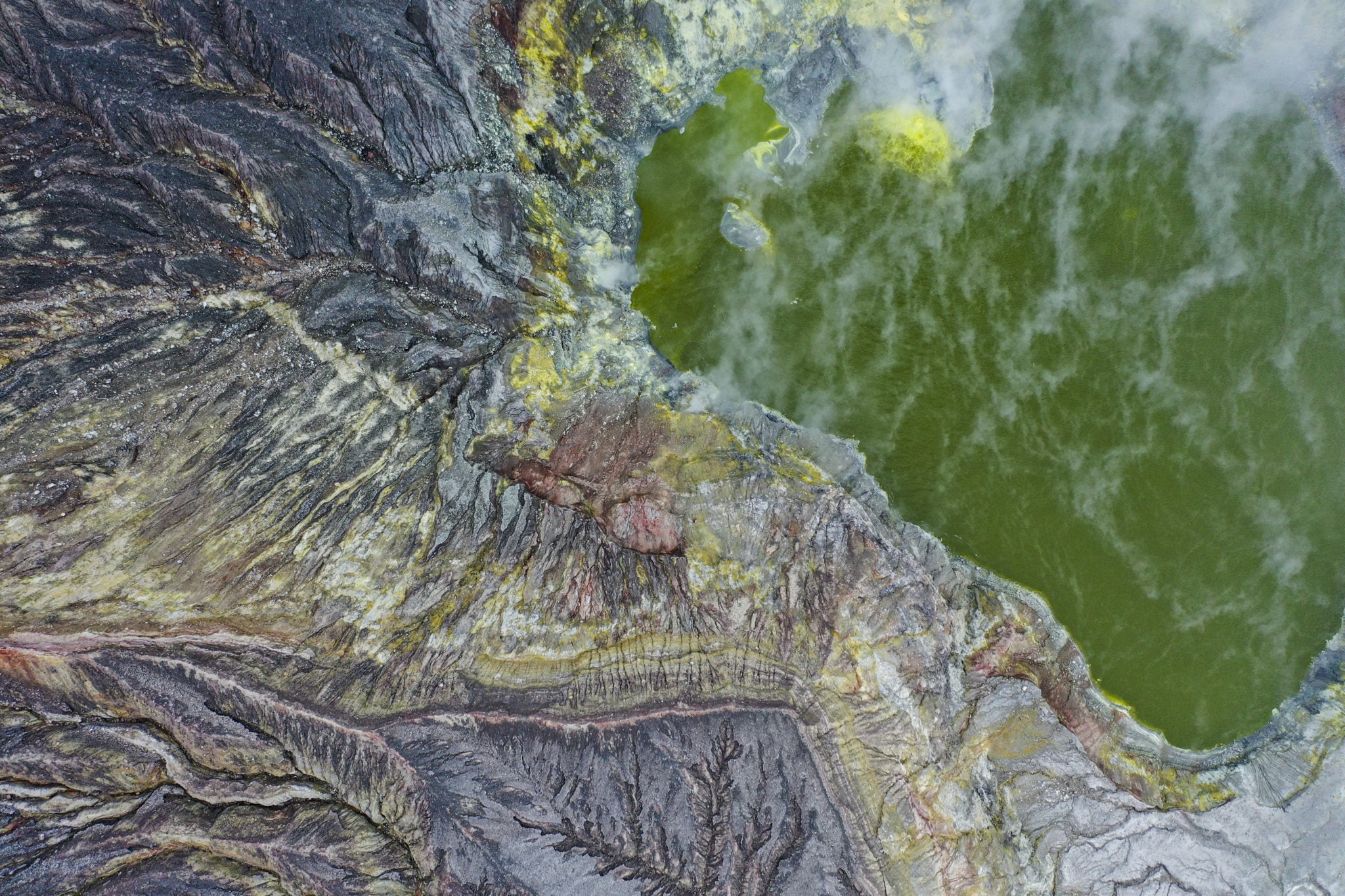
A lake of hot acid fills Whakaari’s western sub-crater. It’s 20–25m lower than the main crater floor. The water, which ranges in temperature from 30ºC to 50ºC, is 60 times more acidic than battery acid. (Image credit: Richard Robinson)
It was initially believed that there were about 100 tourists on or near the island when the eruption took place; later, this figure was revised to 47 people who were on the island at the time. Of these people, 38 were passengers on a shore excursion from the cruise ship Ovation of the Seas, which was on a 12-day voyage around New Zealand and had berthed at the Port of Tauranga that morning.
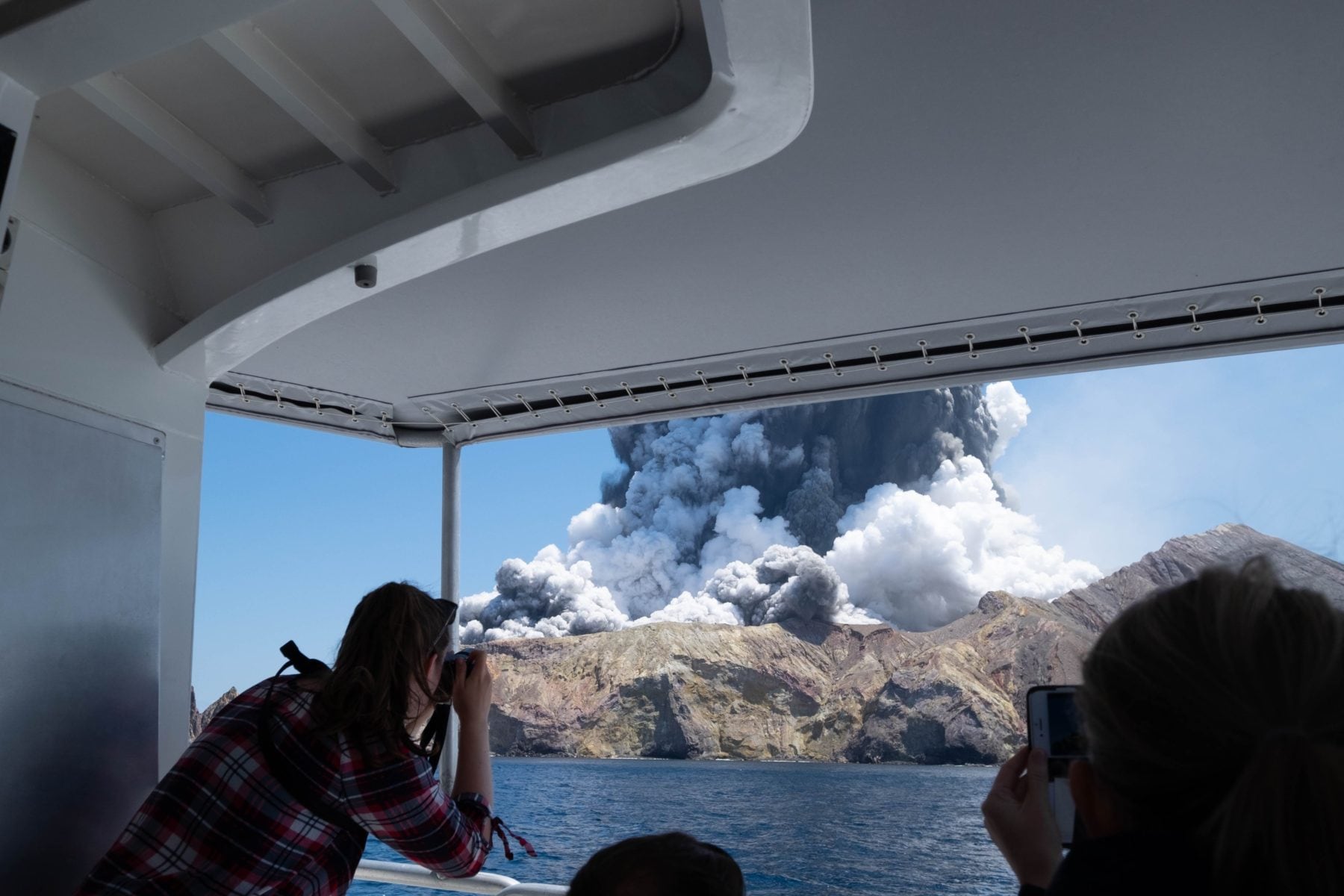
At 2.12pm American tourist Michael Schade photographed the eruptive column surging into the sky from tour boat Phoenix. The last photo he had taken while still on the island was date stamped 1.49pm – 22 minutes before the deadly eruption. (Image credit: Michael Schade)
Some visitors were waiting for vessels to take them off the island at the time of the eruption. Tour operators and these vessels rescued 23 people from the island before it was officially declared unsafe.
A passenger on one of the boats stated that his vessel attempted to first outrun the ash cloud before many on the vessel noticed a crowd of people in need of help on the jetty. Those who were brought onto the boat were aided by the original passengers who used water bottles, jackets and other clothing, inhalers, and eye drops.
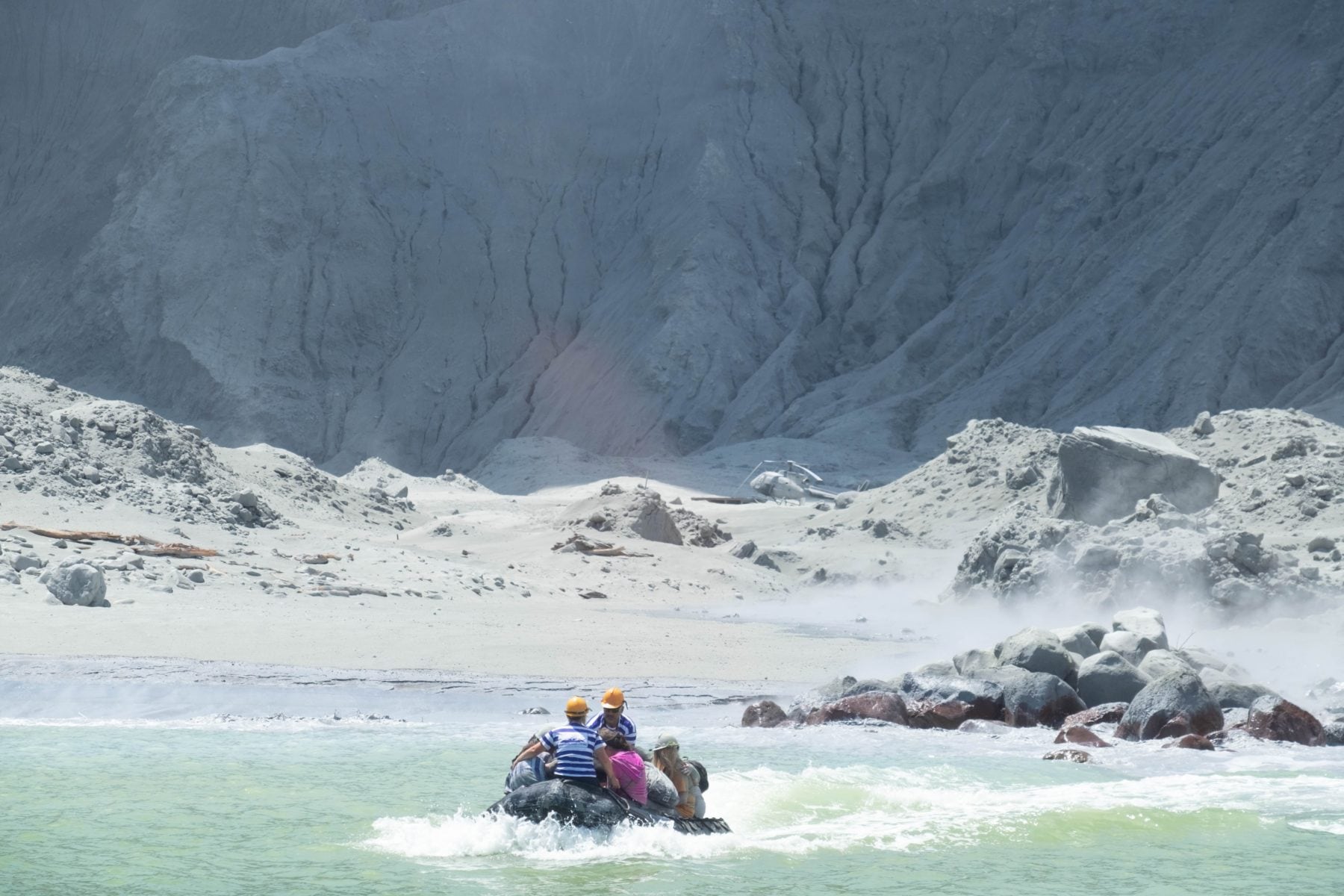
By 2.24pm White Island Tours guides (in blue striped shirts) were rescuing survivors from the landing aboard Phoenix’s inflatables, a scene also photographed by tourist Michael Schade. (Image credit: Michael Schade)
Another passenger told reporters that the boat he was on, which was about 200 metres (220 yd) offshore at the time of the eruption, launched an emergency inflatable and retrieved 23 people before returning to the mainland. Paramedics from the New Zealand Coastguard boarded the boat before it reached the docks to tend the injured.
Noticing the eruption from the mainland shore, three commercial helicopter pilots conducted rescue missions to the island in their helicopters, bringing back twelve survivors. They also saw several bodies in the area, but concentrated on bringing back the survivors. The pilots reportedly attempted to return to the island to collect the bodies they had seen but were stopped by police; however, they were consulted later in order to collect the bodies once the area became more stable.
As the sea-to-shore rescue got underway, an air-to-ground rescue was assembling. The rising plume from Whakaari had served as a shrill alarm for pilots from Whakatane, Rotorua and Taupo. Mark Law, head pilot of Whakatane-based helicopter operators Kahu NZ, saw the eruption as he drove back from Tauranga in his car. He got on the phone, and the Kahu base confirmed that GNS Science’s monitoring cameras on the island had blanked out. Simultaneously, high above the blue expanse of the Bay of Plenty, a helicopter pilot who had lifted off from Whakaari just six minutes earlier called his head pilot, Tim Barrow, at Volcanic Air, and described the scale of the eruption. Barrow then called Law.
Meanwhile, retired helicopter rescue pilot John Funnell was in the air in a small fixed-wing aircraft near Whakatane, keeping up his flying hours. As two Kahu choppers prepared to lift off for Whakaari, with pilots Law, Jason Hill and Tom Storey aboard, Funnell was enlisted as ‘top cover’, a specific role within emergency operations – the top cover is the fixed-winger that circles high above the scene and transmits information received from the team below.
So a small airborne unit was formed, bound together not by official roles or rehearsals, but by the natural meshing of grave concerns and aided by local knowledge of landing pads within the crater.
In December 2022, Netflix released The Volcano: Rescue from Whakaari and used first person accounts along with footage of the eruption and its aftermath, to document the time leading up to, during and after the eruption. I have watched it and can thoroughly recommend it.
A court ruling found the owners of Whakaari/White Island volcano guilty of failing to adequately communicate the risks to visitors touring the active volcano by breaching workplace safety laws. The company, Whakaari Management Limited - the holding company of landowners Andrew, James and Peter Buttle - had not met its obligations to visitors to the volcano.
In March 2024, the Auckland District Court ordered the company that owns the island, Whakaari Management Limited (WML), to pay NZ$4.57m in damages to victims.
WML - which manages the privately-owned island on behalf of a family - licenced tour groups to visit the volcano.
The court also ordered White Island Tours, the company which had brought the tourists to the island for a walking tour, to pay NZ$4.68m in reparations.
Three other tour companies, Volcanic Air Safaris, Aerius Limited and Kahu NZ Limited, were also ordered to pay damages.
Post Script – 2025: When the Courts Looked Back, Accountability Slipped Away
As the years passed and grief settled into something quieter but no less present, many hoped the courts would deliver the one thing the volcano could not: certainty.
But on 27 February 2025, the High Court overturned that conviction entirely.
Justice Simon Moore ruled that WML, though earning around NZ$1 million a year in tour licence fees, had no “management or control” over the walking-tour operations on the island. Under section 37 of New Zealand’s Health and Safety at Work Act, that responsibility belonged to those running the tours day-to-day - not passive landlords.
Moore noted the tragedy’s enormity and stated plainly: “The 47 people who were on Whakaari at the time it erupted should never have been there.”
Yet he cleared WML on the grounds that the Buttles had relied on official agencies - GNS Science, Emergency Management Bay of Plenty - for risk monitoring, and that commissioning their own independent risk assessment wasn’t “reasonably practicable.”
To many, it felt like a legal loophole big enough for an entire volcano to fall through.
Victims’ families were devastated. Millions in reparations were wiped away in an instant. Lawyers called it a blow to accountability. WorkSafe has signalled it may appeal, but for now the Buttles walk free of criminal conviction while civil claims trudge on in U.S. courts, particularly against cruise operators like Royal Caribbean who delivered tourists to the island that day.
This court ruling does not change the heroism etched into that terrible day - the crew of the Phoenix, the pilots, the rescuers who stepped into a nightmare of ash and steam and still pulled survivors out. Their actions remain the purest truth of White Island.
But it does sharpen a bitter edge:
While ordinary people risked everything to save strangers, the systems meant to protect those visitors were riddled with blind spots - risk assessments unmade, warnings unheeded, oversight blurred across agencies. Justice Moore himself acknowledged that if WML had been compelled to obtain a fresh GNS risk report, the rising unrest of the volcano - the heating lake, the tremors - might have shut tours down in time.
BLOG COMMENTS POWERED BY DISQUS


