
The PR Blog
- Details
- Written by: Op-Ed Flysa

Gold is known as a noble metal in that it will never rust, and is not affected by most acids and chemicals. It can however be dissolved by a mixture of hydrochloric and nitric acid known as aqua regia(Latin royal water), or by sodium cyanide, or by acetic acid mixed with certain oxidants.
From time immemorial gold has been the desire of those aspiring to riches, or to make sacred or venerable objects. Examples are the Israelites in the Bible worshipping a golden calf when Moses came down from Mount Sinai, and Jason and his Argonauts searching for the Golden Fleece.
Read more: I remember... the golden days of my youth
- Details
- Written by: Op-Ed Happy Expat

From a very early age I learned that the two inventions that Australia was most famous for were the combine harvester and the stump jump plough. Here is the story of the combine harvester now used around the world in their thousands and the origins long forgotten.
Hugh Victor McKay (1865-1926) was born at Raywood in Victoria, the fifth of 12 children of Nathaniel McKay and his wife Mary. They had emigrated to Australia from County Monaghan in 1852, drawn like thousands of others to the Victorian goldfields.
Nathaniel abandoned gold mining to become a stonemason and then became a farmer. The children had limited schooling, but all eight sons became successful in a variety of fields. Hugh Victor left school when he was 13 to help on the family farm and it was in agriculture that he was to make a great impact.
As an adult he became aware of a Victorian government prize available to a person who succeeded in building a machine that was capable of combining the four activities required in harvesting cereal crops: stripping, threshing, winnowing and bagging. In 1885, with his father and brother John, he assembled a stripper-harvester from pieces of equipment on the farm. This was a prototype and Hugh Victor went on to build harvesters under contract as the McKay Harvesting Machinery Company. The company traded successfully until the Australian banking crash of 1892-93 caused its closure.
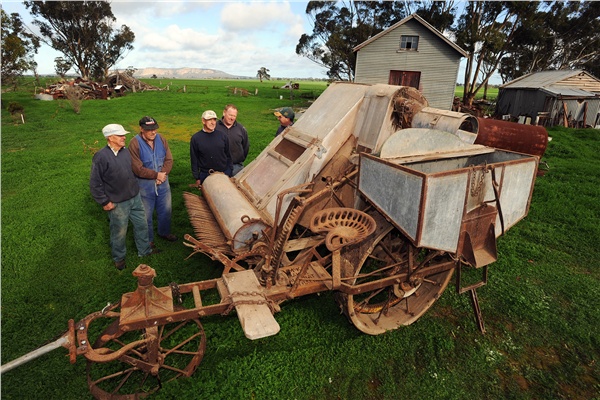
RELIC FROM THE PAST: Allen Webb, Neil Hateley, Colin Webb, Euan Hateley and Andrew Hateley admire the historic H.V. McKay harvester before moving it to Natimuk on Friday. The machine is more than a century old. Picture: KATE HEALY
McKay was not deterred and with the backing of rural businessmen he established The Harvester Company and produced an improved machine he called “the Sunshine”. Orders trickled in at first, but as more farmers bought Sunshine harvesters, production increased. Fifty were sold in 1896 and sales rose to 500 in 1901. An export trade developed with machines being sent to South Africa and Argentina.
Help us cover our monthly costs
By 1905 the Sunshine Harvester works in Ballarat were employing 500 people. A succession of improvements to the manufacturing process improved efficiency and output continued to grow - some 1,916 machines were sold in 1905-6. McKay seized the opportunity to purchase The Braybrook Implement Company on the outskirts of Melbourne in order to expand Sunshine Harvesters.

'Sunshine' stripper-harvester made by H.V. McKay Pty Ltd
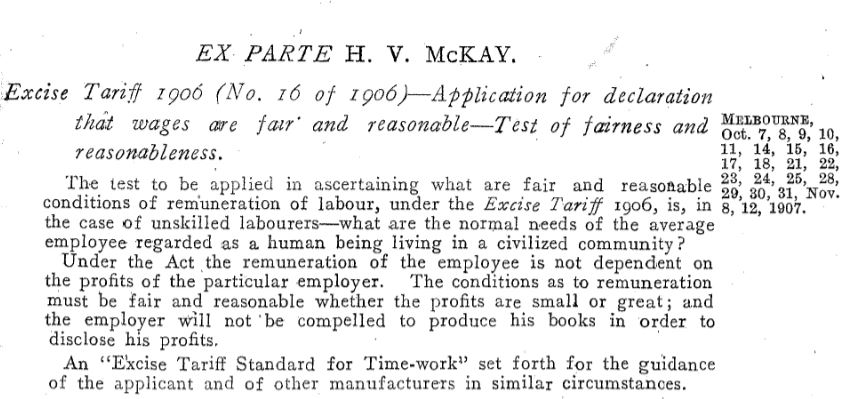
He sought tariff protection from foreign competitors that he asserted were copying Sunshine harvesters and this led him into campaigns and legal disputes. They culminated in the Harvester Judgement of 1907 in which the judge dictated minimum wage rates for an eight-hour day.
The Harvester Judgement was the first decision handed down by Mr Justice Higgins, the new President of the Commonwealth Conciliation and Arbitration Court created in 1904. In his judgement Higgins J defined a “worker” as :- ‘a… human being in a civilized community entitled to marry and raise a family.’
He went on to say that “The wages paid had to reflect the reality of a worker providing the basic needs for a family of five and to define this Higgins took the radical approach of interviewing not only male workers but also their wives.”
In his judgement, Higgins calculated that a fair and reasonable wage for manual workers was seven shillings per day or 42 shillings per week.

McKay did not accept the judgement and appealed to the High Court which, in 1908, overturned it as unconstitutional, invalid and void. It ruled that the Constitution permitted the Commonwealth to levy Customs and Excise Duties but not to determine wages and working conditions. Higgins J was also a judge on the High Court bench.
In 1910 the Agricultural Implement Makers’ Union called a strike to which the company replied with a lock-out that lasted 13 weeks and left the union bankrupt. The impacts on industrial relations in Australia lasted for decades and the concept of a minimum wage was to endure.
McKay decided to invest in industrial peace by creating a company town at Braybrook, which was, and still is, now known as Sunshine. Modelled on examples such as Port Sunlight (Lever Brothers) and Bourneville (Cadbury’s) it provided housing and sporting and cultural facilities. Several McKay families lived at Sunshine including Hugh Victor’s until he moved to a grand mansion, “Rupertswood”, near Sunbury.

The Sunshine Harvester Works was the largest manufacturing company in Australia by the 1920s with buildings extending over 12 hectares. By this stage it was making a wide range of agricultural machines and continued to innovate and invest. Henry Victor ruled the organisation as a director with absolute control which continued until his death from lung cancer at the age of 60 on May 21st 1926. The business continued, eventually merging with that of Massey Harris.
Hugh Victor McKay paid at least one visit to Ireland. In the collection cared for by Museums Victoria is a photograph of him with a group enjoying a ride in a horse-drawn carriage somewhere in Ireland and another shows him and Mrs McKay at the Giants Causeway, County Antrim. Several photos feature HV MacKay and friends in Ireland riding in a white Lanchester touring car. It is likely that the Irish visit took place after a visit to the Western Front in 1914. Another image in the Museums Victoria collection is of him looking at the shattered remains of the medieval Wool Hall in the Belgian town of Ypres.

Hugh Victor McKay and his companions sitting in a horse-drawn carriage in Ireland circa 1912. Photograph: Museum Victoria
The HV McKay Charitable Trust, created at the time of his death, carries his name on. It offers support to community ventures in rural Australia. One of his last acts was to lay the foundation stone of the Presbyterian Church at Sunshine a few days before his death. It is situated in the HV McKay Memorial Gardens that continue to provide a pleasant amenity for the people of Sunshine.

In 1953 The Sunshine Harvester Co merged with the Canadian implement manufacturer Massey- Harris for which it had been the exclusive Australian distributor since 1930. The name changed to H. V. McKay Massey Harris Limited then in 1958 Massey Harris merged with the British tractor manufacturer Ferguson. In 1958 the name was changed again to Massey Ferguson Limited. The Ferguson tractor is embedded in Australia’s agricultural history as one of the enduring mainstays of countless farms across the country. There are plenty of little Grey Fergies and Red Fergies still in use today. When our family had the farm at Kerang I had four Red Fergies. They would be nearly 70 years old now and one that I kept was in regular use at my brother’s vineyard until three years ago when I gave it to my niece who bought a small property at Swan Hill. It is still going strong and never misses a beat.

Unfortunately the march of overseas manufacturing caught up with Massey Ferguson like it did with many other iconic Aussie manufacturers. Production at Sunshine ceased in 1986 and the whole complex was demolished in 1992 save and except some key features which are listed on the Victorian Heritage Register and still stand today.
In producing the foregoing I am indebted to Dr. Patrick Greene, CEO and Director of EPIC, The Irish Emigration Museum in Dublin. The EPIC Museum tells the stories of Irishmen who have emigrated and found success in foreign lands and influenced the World.
- Details
- Written by: Op-Ed Monty

As has been reported on Gateway Pundit, The results from canvassing efforts in Arizona are now out…this is a separate exercise from the Maricopa County audit the Arizona Senate is sponsoring.
However, for all of those who knew this election was stolen, those who were ridiculed or labeled conspiracy theorists – You have been vindicated. Perhaps this is an opportunity to revisit a landmark decision handed down by the United States Supreme Court in the case of The United States versus Throckmorton.
- Details
- Written by: Op-Ed Guest Post

“Gold is the primary store of value for those who mistrust the government, but silver remains the refuge of choice for most people because it is cheaper and more accessible.”
The aptly-named New York University professor William Silber wanted to title his book “Silber on Silver” – but his publisher instead had him settle for The Story of Silver: How the White Metal Shaped America and the Modern World. The wittiness of that remark in the acknowledgements shows the many instances of snark, irony, or amusing tales that are scattered throughout this excellent contribution to the history of monetary commodities. Always playing second fiddle to gold, silver’s status as asset and as money is as riveting as the more widely known history of gold.
- Details
- Written by: Op-Ed Monty

It is a strange world that we live in, isn't it? There is so much that cannot be explained by " science " yet we drag out the " science " word with such ease and dismiss God with equal ease.
- Details
- Written by: Op-Ed Guest Post

Marie Stopes Australia has closed four of its Queensland clinics. The clinics, located in Townsville, Rockhampton, Southport, and Newcastle employed over 40 staff and performed around 5,000 abortions annually.
Managing director Jamal Hakim described the closures as “a really difficult decision“.
- Details
- Written by: Op-Ed Shaydee Lane

The whole debate over the Bible stories is often held up for ridicule by those who believe that the most popular book ever written is a load of tosh and well, simply laughable.
Yet, strangely enough, the very people who scoff at the wisdom of The Bible, are the first to believe in the book of Biden and the forbidden jab in the Garden of Pfizer.
- Details
- Written by: Op-Ed Flysa

As any old person who has been interrupted by a checkout assistant at a do-it-yourself supermarket scanner would agree, there is a general perception among the younger members of the community that we oldies are senile and useless. While refusing to let the unwelcome interloper scan for me, I always remember the great poem Ulysses by Lord Tennyson, which ends with the following lines:
- Details
- Written by: Op-Ed Happy Expat

This topic has been prompted by comments from knitters on my last dissertation “The Men Who Saved Australia”. I was surprised that it arose in the way it did because the role of the Japanese escort with the first ANZAC fleet was touched on in my series on the first HMAS Sydney and its fight with the Emden.
The history of Japanese and British alliance is a maze that keeps going back at each stanza of the relationship but in the interests of brevity and completeness, I am starting with the Anglo-Japanese treaty of 1902.
- Details
- Written by: Op-Ed Viv Forbes

Growing trees need three essentials – radiant energy from the sun, CO2 and rain from the atmosphere, and nutrients and minerals from the soil. Climate alarmists correctly claim that burning forest products in thermal power stations is “net-zero emissions” because burning the wood just puts the same CO2 back into the atmosphere. Identical reasoning applies to grazing cattle.
- Details
- Written by: Op-Ed Shaydee Lane

- View all
- Blog
- Hmmm....
-
Newsflash! America Does Not…
I have been asked to revisit a story published by the Dusty Gulch Gazette in…
57 hits
-
There's Gold in Them…
What Happened to McFookit Peak? By Roderick “Whiskers” McNibbleDusty Gulch Gazette It was midnight when…
125 hits
-
Home Children - A…
Between the mid-19th and early 20th centuries, more than a hundred thousand British children were…
198 hits
-
The Friends in Times…
The Battle of Britain ended on 15th September, 1940 but the Blitz continued long after that. Following…
174 hits
-
When Words Become Knives
Words. We use them every day without giving them much thought. We write them in…
221 hits
-
When Leadership Gives Courage…
As our countries struggle under the weight of wokeism, ideological conformity and the relentless erosion…
221 hits
-
What the Mailbox Knew…
The Lost Art of Letter Writing In an age of glowing screens and fleeting texts,…
197 hits
-
Rebels In Need of…
As young folk, didn't some of us feel like rebels without a cause? I am…
246 hits
-
There’s Meat on the…
There’s Meat on the Bone A Ratty News Investigation By Roderick “Whiskers” McNibbleChief Investigative Correspondent,…
213 hits
-
The baton we carry,…
The baton we carry, and the history we must pass on For twenty-five years, I…
143 hits
-
The Great Dog-Fence Summit
DUSTY GULCH GAZETTE Special Political Correspondent EditionFiled from the wrong side of a perfectly ordinary…
264 hits
-
The Timeless Strategy of…
I’m a teacher who’s spent years studying history and who cares about using words honestly.…
248 hits
-
All Available Boats
When I was a child, I loved a story about little tugboat called Little Toot.…
309 hits
-
You Either Get It…
You Either Get It or You Don’t People have lost their sense of humor. Not…
260 hits
-
The Hole in the…
The Alfred Graving Dock - a monument to Victorian engineering and Australian shipbuilding Most readers…
265 hits
-
Twelve Angry People
Twelve Angry People What 12 Angry Men can teach us about the hardest job in…
181 hits
-
The Strange Case of…
THE GREAT MULBERRY VACCINATION SCANDAL A Ratty News investigation by Roderick “Whiskers” McNibble I knew…
286 hits
-
Does Australia Pass the…
Is Australia Becoming a Pub With No Affordable Beer? Oh, sure, the beer is still…
355 hits
-
The Road to War
The War Did Not Begin on 1 September 1939 The details of Adolf Hitler’s rise…
304 hits
-
The Weimer Republic Mk…
In the shadow of a shattered empire, the Weimar Republic rose in 1919, promising democracy,…
310 hits
-
A Moment in Time...
There are memories that refuse to grow old. The 29th anniversary of Princess Diana’s death…
323 hits
-
From Eureka to Extinction…
The result of the recent bi election in Secret Harbour in WA sends a powerful…
332 hits
-
A Dispatch From the…
A Dispatch from the Pointy End Foreword By Roderick (Whiskers ) McNibble, Senior Investigative Rodent…
319 hits
-
The Dunny Dilemma -…
PLUMBING! The Mayor Has Finally Met a Pipe He Can't Fix A Special Medical -…
342 hits
-
Milne Bay - Australia's…
“Some of us may forget that, of all the Allies, it was the Australians who…
383 hits
-
The Grave Where Nothing…
Where Do the Children Play? I have no opinion to offer publicly on the Lindsay…
317 hits
-
The 1951 Waterfront Lockout…
In early 1951, New Zealand’s waterfronts weren’t just bustling ports - they had become battlegrounds.…
302 hits
-
The Difference Between Understanding…
What badly behaved cats might teach us about excuses, responsibility and the people we sometimes…
342 hits
-
"It's a Mini!" -…
Few cars trigger as much nostalgia as the iconic Mini. Born in post-war Britain, the…
339 hits
-
Look Where You Are…
What falling over at seventy taught me about scars, consequences and the dangers of rushing…
325 hits
-
How we Saved the…
And Why Trevor the Wallaby Is No Longer Allowed Near the Taj Mahal An exclusive…
369 hits


