

Oil & Coal: The Twin Engines That Built Our World - And the Politicians Want to Pull the Plug
Every time I hear some politician, influencer or green-tinged academic lecture me about “transitioning away” from fossil fuels, I look around my house and wonder what planet they're living on.
Not this one, clearly.
Because on this planet - the one with rain, dust, deadlines, tractors, hospitals, factories, shipping lanes and people who need electricity when they turn on a switch - coal and oil did rather more than keep the lights on.
They helped build the modern world.
So pull up a chair, grab a beer and let's have a yarn about how we got here. No lectures, no fashionable slogans and no pretending that civilisation sprang fully formed from a solar panel and a tofu fry up.
First, though, we need to wind the clock back.
Before the world had an engine
For most of human history, getting things done required muscle.
Human muscle. Animal muscle. Water turning a mill wheel. Wind filling a sail. Wood burning in a hearth.
People could build magnificent things, trade across oceans and produce extraordinary works of craftsmanship. But there were limits to how much they could make, how far they could transport it and how quickly they could do either.
Then came coal.
Coal had been used for centuries, but its importance grew enormously as Britain entered the Industrial Revolution during the eighteenth century. It provided concentrated energy for industries that had previously depended heavily on wood, charcoal, water power and human or animal labour.
Coal could heat furnaces, help produce iron, power steam engines and supply the energy needed to run increasingly large factories.
That changed the scale of what human beings could accomplish.
And once the change began, it gathered momentum.
Coal: The fuel that got industry moving
One of the early problems of mining coal was water. Dig deep enough into the earth and sooner or later the water comes in, making further mining difficult or impossible.
In 1712, Thomas Newcomen developed a practical steam engine to pump water out of mines. It was an important breakthrough, although it consumed enormous quantities of coal.
James Watt's subsequent improvements made steam engines considerably more efficient and useful for purposes beyond pumping mine water.
Now we had something remarkable: a machine that could convert heat into mechanical work on a scale that was becoming increasingly practical for industry.
Factories could use steam power without having to sit beside a fast-flowing river. Machinery could do work previously performed by people and animals. Production could expand beyond the limitations of individual workshops and the strength of their workers.
Textiles, mining, ironmaking and manufacturing were transformed over time.
No, the Industrial Revolution did not happen overnight, and coal wasn't the only reason it happened. Inventors, entrepreneurs, workers, scientific discoveries, capital and trade all played their part.
But coal supplied much of the energy that allowed those developments to grow beyond what had previously been possible.
It was a partnership between human ingenuity and a powerful source of energy.
And that partnership would change the world.
Steel: The bones of the modern world
Let's talk about something we tend to take for granted.
Steel.
Look around you. Bridges, railway lines, factories, ships, machinery, tools and the framework of countless buildings depend on iron and steel.
For centuries, iron production relied heavily on charcoal made from wood. That placed limits on the quantities that could be produced economically.
In 1709, Abraham Darby demonstrated the use of coke, produced from coal, to smelt iron. The technique developed over subsequent decades and helped remove one of the constraints on expanding iron production.
Then came further advances in steelmaking during the nineteenth century, including Henry Bessemer's process, patented in 1856, which made mass production of steel much cheaper and more practical.
The consequences were enormous.
Railways could expand. Bridges could span greater distances. Industrial machinery could be manufactured in greater quantities. Ships, tools and structures could be built on a scale that had previously been prohibitively expensive.
Coal was not the sole ingredient in these achievements, but it supplied crucial energy and industrial materials.
And here's something worth remembering when we talk about replacing fossil fuels.
Steelmaking is not the same problem as generating electricity. Traditional blast furnaces depend on coke for both heat and chemical reactions involved in reducing iron ore. Alternative methods exist, but they require different processes, equipment, energy supplies and investment.
You cannot replace one industrial process simply by announcing that you would prefer another.
The engineering has to work.
Oil: When the world found its wheels
Coal was already changing industry when petroleum began opening another chapter.
For much of the nineteenth century, refined petroleum was used principally for products such as kerosene, which became an important source of lighting.
The oil industry expanded rapidly after the drilling of a commercial oil well at Titusville, Pennsylvania, in 1859. Discoveries, drilling technology, refining and growing markets helped turn petroleum into a major industrial commodity.
Then came the internal combustion engine.
Inventors had experimented with such engines before, but developments during the late nineteenth century made them increasingly practical. Karl Benz patented his motor car in 1886, while Gottlieb Daimler and Wilhelm Maybach developed their own petrol-powered vehicles.
The motor car was born not from a single invention, but from a series of advances in engines, fuel, materials and manufacturing.
Henry Ford didn't invent the automobile. What he helped do was make it affordable to a much larger public through mass production.
His Model T, introduced in 1908, became a symbol of a revolution in personal transport.
People who had depended on horses, bicycles, walking and public transport gained a new degree of personal mobility. Farmers could reach markets more readily. Businesses could transport goods beyond the immediate neighbourhood. Roads, service stations, workshops and entirely new industries grew around the motor vehicle.
The car didn't merely change how people travelled.
It changed where they could live, work and trade.
And petrol was central to that transformation.
From the road to the sky
Oil's influence did not stop at the roadside.
Early aviation relied on lightweight internal combustion engines burning liquid fuel. During the First World War, aircraft developed rapidly from fragile machines into increasingly capable military tools. In the decades that followed, aviation advanced into passenger transport, commercial freight and long-distance international travel. ( More on this later. )
Jet engines brought another leap forward during the twentieth century, using kerosene-based aviation fuel to power aircraft over enormous distances.
Today, conventional aviation remains overwhelmingly dependent on liquid fuels.
Alternative aviation fuels and other technologies are developing, but replacing the energy carried by conventional jet fuel presents a substantial engineering challenge, particularly for long-distance flights.
The point is not that aircraft will never change.

It's that the aircraft flying today did not become possible merely because somebody wanted them to. They became possible because engineers developed engines, materials, fuels, manufacturing methods and the infrastructure to support them.
Oil helped supply the energy that made this extraordinary expansion possible.
The ships that connected the world
Now consider the cargo ship.
Before modern shipping, moving large quantities of goods over long distances was slower, more expensive and often more difficult to organise.
Coal-fired steamships expanded the possibilities of maritime transport during the nineteenth century. Later, oil-fired machinery and diesel engines offered advantages in fuel handling, efficiency and the space available for cargo.
As ships grew larger and transport networks expanded, the cost of moving many goods across the world fell dramatically.
Today, seaborne trade carries the great majority of world trade by volume.
The food we import, the machinery we buy, the materials used in construction and the components required by factories may have travelled through several countries before reaching their destination.
Oil-derived marine fuels remain important to the global shipping fleet.
Think about that next time you order something online and complain that delivery is taking three days instead of two. Or, in PP's case, three weeks.
The modern world depends on an extraordinary transport network. It is supported by ships, ports, trucks, railways, warehouses, fuel supplies and the people who keep them operating.
That network did not appear by magic.
And while the fuels and technologies used in transport can change, the work still has to be done.
Electricity: Bringing power into the home
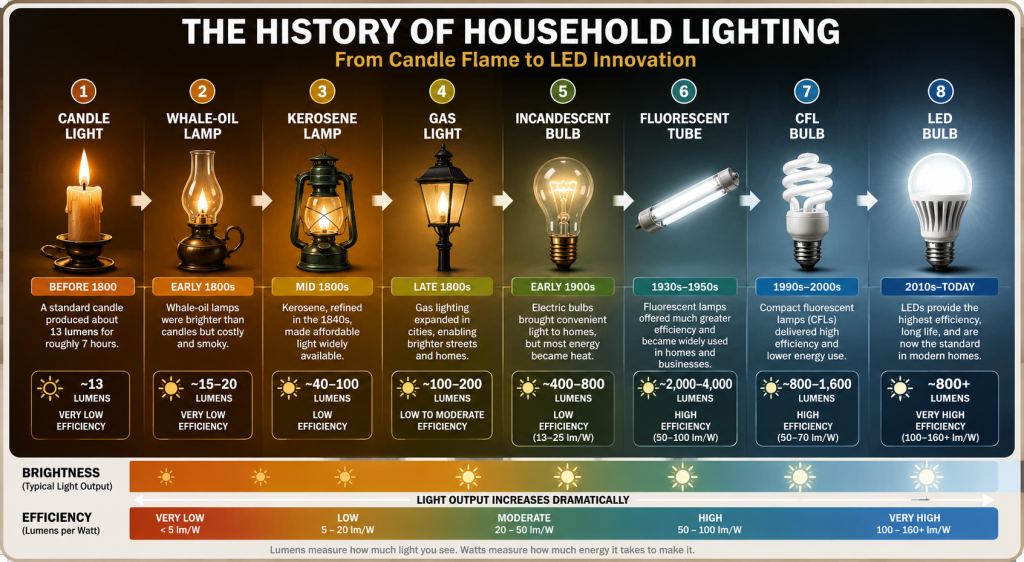
Electricity itself was not new. Scientists and inventors had been studying and experimenting with it for generations. What was changing was the development of practical generating systems and networks that could supply it to homes and businesses.
Coal-fired power stations became important components of electricity systems as these networks expanded.
Electric lighting changed homes, streets, factories and workplaces. Electric motors transformed industrial production. Refrigeration improved food storage. Communications, appliances and countless later technologies became possible on an increasingly large scale.
Other energy sources also played essential roles, including hydropower, and electricity generation subsequently diversified further.
But coal became one of the great industrial fuels of the modern era, helping supply the energy that powered the growth of cities, manufacturing and electricity networks.
And it still supplies a substantial share of the world's electricity today.
That is not a recommendation to burn coal indefinitely. It is a recognition of the scale of the system that has grown around it.
Replacing coal-fired electricity involves more than switching off a power station. Electricity must still be generated, transmitted and delivered when people and industries need it.
The replacement system must do the job.
And natural gas, which expanded in use as drilling, pipelines and distribution networks developed, would become another major part of the modern industrial system - supplying heat, electricity and feedstocks for the manufacture of chemicals and fertilisers.
Coal and oil were not the end of the story. Natural gas would later become another major player in modern industry, supplying heat, electricity and feedstocks for chemicals and fertilisers. But gas has its own history, and it deserves a story of its own. We'll come to that another day.
Which brings us to the curious part.
We have built a world that depends on vast quantities of energy and materials. We have become accustomed to goods arriving when we want them, electricity being available at the flick of a switch and transport carrying us across distances that would once have consumed days or weeks.
We rarely stop to consider the industrial foundations beneath those conveniences.
Until somebody proposes removing them.

So, where does that leave us?
The Industrial Revolution did not emerge from a slogan. The motor car did not appear because a government announced a target. The electricity grid was not built by wishing for one.
People invented things, tested them, improved them, built the infrastructure and made them work.
That is how progress happens.
And if we are going to make another great change in the way the world produces and uses energy, surely we should apply the same practical discipline.
Because coal and oil did more than fuel machines.
They helped create the very system we now propose to transform.
Before we decide how quickly that transformation should happen, perhaps we ought to understand what we have built, what still depends on it, and what will be required to replace it.
That's not an argument against progress.
It's an argument for knowing what we're doing.
And that, I reckon, is a sensible place to begin. Because, if not, is it lights out for the modern world?
Monty
BLOG COMMENTS POWERED BY DISQUS


