

Mahia: Where the Sheep Graze and the Rockets Fly
How a little bit of Kiwi ingenuity could help build the next frontier of artificial intelligence.
New Zealand has just been to the polls. Politicians have spent months telling voters what they intend to do with the country, what needs fixing, what needs changing and, naturally, why they are the people to do it.
But while the political circus has been packing up its tents, something rather more extraordinary has been happening on a quiet stretch of New Zealand's North Island east coast.
There are sheep grazing.
And rockets launching.
Not quite the usual combination, is it?

Some years ago, when I first started this blog, I wrote about this amazing place and something quite extraordianry happening there. A remarkable little enterprise had put this otherwise peaceful rural landscape on the international space map.
Rocket Lab operates Launch Complex 1 there, the world's first privately built and operated orbital launch site. The surrounding countryside remains gloriously rural. Green paddocks roll towards the Pacific, sheep get on with their grazing, and the grass still needs cutting.
The sheep, incidentally, have never shown much interest in rocket science. Their contribution to the operation appears to be keeping the lawns tidy. Or have they? Over recent years, perhaps they outsourced to others... who knows?
But behind the scenes, the people involved have been doing something rather spectacular.
And there is a lesson in this story that goes well beyond rockets.
A little country with rather large ideas
New Zealand is not exactly a global heavyweight when measured by population, industrial muscle or economic size. Geographically, it sits at what some might affectionately call the arsehole end of the earth. As a Kiwi by birth and an Aussie by adoption, I approve of the phrase because it is quinessentially us. We don't mind being the butt of a joke.
Yet, for some amazing reason, Kiwiland has a habit of producing people who aren't particularly interested in being told what a small country can or cannot achieve. Sir Edmund Hillary and Ernest Rutherford spring to mind.
Peter Beck is also one of them.
The founder of Rocket Lab set out to build a commercial space business in an industry traditionally dominated by governments and enormous aerospace corporations.
It was an ambitious undertaking. Building rockets is not cheap, getting them into orbit is considerably harder than getting them off the ground, and the competition is hardly short of resources.
But Beck and his team got on with it.
Rocket Lab began launching its Electron rocket from Mahia in 2017. Since then, the company has developed into an international launch and space-systems business, supplying launch services and spacecraft technology to customers around the world.
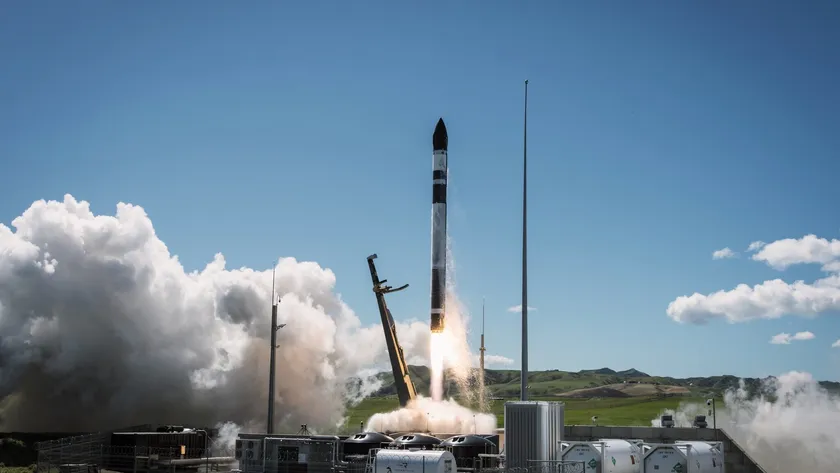
Its latest milestone came on the 2nd of November 2026, when Electron completed its 99th mission, delivering another Japanese Earth-imaging satellite for iQPS into orbit.
Not bad going.
Why Mahia?
There is a reason Rocket Lab chose this particular stretch of coastline.
Launching a rocket is not simply a matter of finding somewhere with enough room and pointing the nose upwards.
You need suitable flight paths, clear airspace, safe ocean corridors and the ability to launch into different orbital inclinations. Māhia offers some very useful geographical advantages, with the Pacific Ocean providing open space downrange.
The launch complex sits on a plateau above the surrounding coastline, on land leased from the local Maori Incorporation. Make of that what you will...
What was once working farmland has become an important piece of international space infrastructure.
The success of Rocket Lab isn't simply a story about clever engineers and expensive machinery. It is also about a location and the practical decisions that made the operation possible.
A remote rural peninsula has found itself participating in an industry that will increasingly influence communications, navigation, defence, scientific research and commercial technology.
Sometimes opportunity arrives in rather unexpected places.
And now comes Elon Musk
Just when you might think Rocket Lab has enough on its plate, along comes another development that could make Mahia even more interesting.
Elon Musk believes that much of the future demand for artificial intelligence computing could eventually be met in space.
Rather than continuing to build enormous data centres on Earth, consuming vast quantities of electricity, water and land, Musk envisages solar-powered computing facilities operating in orbit.
His argument is that space offers an abundant supply of solar energy, fewer terrestrial land and water constraints, and opportunities for cooling systems that don't depend on the same infrastructure as conventional data centres.
At Davos in January 2026, he described solar-powered AI data centres in space as a "no-brainer". He has continued to promote the concept, suggesting that orbital computing could eventually dwarf the capacity being added on Earth.
That's a rather large ambition, even by Elon standards.
But before we all start imagining giant computer factories floating above our heads, there are some considerable challenges.
Radiation can damage electronics. Equipment has to survive extreme temperature changes. Heat still has to be removed, despite the popular misconception that everything in space simply freezes. Repairs and replacements are difficult, and launching all that equipment costs money.
There are also questions about orbital congestion, communications and the economics of building and maintaining such systems.
And here's where our little Kiwi enterprise comes back into the picture.
The clever buggers from Kiwiland
Rocket Lab isn't proposing to become another SpaceX, nor is it currently planning to operate its own orbital AI data centres.
But it has recognised that if this industry develops, somebody will need to supply the technology that makes it possible.
In February 2026, Rocket Lab announced advanced silicon solar arrays designed specifically for the enormous power requirements of space-based computing platforms.
The company already manufactures space-grade solar cells and panels. Its new technology is intended to provide a more economical and scalable way of generating electricity in orbit.
After all, computers need power. Lots of it.
And if we're going to put increasingly powerful computing systems into space, we're going to need some rather impressive solar equipment to keep them running.
Rocket Lab wants to be part of that supply chain.
It can potentially provide solar power systems, spacecraft components and launch services to companies developing the next generation of orbital infrastructure.
Musk may have the grand vision, the enormous rockets and the ambition to put artificial intelligence above our heads.
But even Elon needs some clever buggers who know how to build the equipment that makes his dreams possible.
And some of those clever buggers come from a little country called New Zealand.
No business operates in isolation. Even the largest companies depend on networks of suppliers, engineers, manufacturers and specialist businesses. The fellow building the solar panels might be every bit as important to the eventual success of the project as the fellow launching the rocket.
And Rocket Lab appears to understand that rather well.
The politicians will change. The work goes on.
This is perhaps the part of the story I find most interesting.
We spend an extraordinary amount of time watching governments. Elections come around, governments change, ministers acquire new portfolios, policies are announced and priorities shift.
But governments don't have a monopoly on the future.
While politicians are arguing about what ought to happen, people in workshops, laboratories, factories and small businesses are often busy making it happen.
They are designing, experimenting, investing, manufacturing, employing people and taking risks. They don't necessarily know whether their idea will succeed. They have no guarantee that the next government will like their industry or even understand it.
They get on with it anyway.
Rocket Lab is a wonderful example.
Peter Beck didn't wait for New Zealand to become a major industrial power before attempting something extraordinary. He built a business around an opportunity, assembled a team and took on an industry in which the established players had enormous advantages.
That is enterprise in action.
It also illustrates something smaller countries should never forget. Population size and geographical distance do not automatically determine what a nation can achieve.
New Zealand may be a long way from Washington, London or Beijing, but it has developed a commercial space capability that attracts international customers and puts its technology into orbit.
That's not a bad return on a bit of Kiwi grass.
But sheep don't rule the world, do they? This is what people often forget.

It is the shepherd who gazes at the sky and ponders : What if?
We don't yet know whether orbital AI computing will become the enormous industry Elon Musk envisages. The technology has hurdles to overcome, and the economics will have the final say.
But the pieces are being developed now.
The rockets are flying. The solar technology is advancing. Businesses are investing in capabilities that may become essential to the next generation of space infrastructure.
And Mahia is already part of that story.
Perhaps the most remarkable thing is that none of this required New Zealand to become a superpower first.
It required people with ideas, the willingness to take risks and the determination to see what could be achieved.
Governments will come and go. Political promises will be made and forgotten. The next election will eventually arrive, bringing with it another round of arguments about the direction of the country.
Meanwhile, somewhere on the Māhia Peninsula, somebody will be checking the rocket, somebody else will be checking the launch systems, and the sheep will be doing their bit for grounds maintenance.

Then, when everything is ready, another Electron will light up the morning sky and head for orbit.
From a little piece of New Zealand grass to the edge of space.
But hell, we need the shepherds gazing into space ansd wondering " what if? " Without them, I wonder.
Somebody would give those sheep a pay rise and fire the shepherd because the fox was offended.
BLOG COMMENTS POWERED BY DISQUS


