

On the evening of 30 October 1938, a young actor and theatrical director named Orson Wells did something that would become one of the most famous experiments in the history of broadcasting.
He frightened America with an invasion from Mars.
Welles, then just 23 years old, was directing The Mercury Theatre on the Air, a weekly radio programme broadcast by CBS. For Halloween, he and his fellow performers had adapted H.G. Wells' science-fiction novel The War of the Worlds, first published in 1898.
It was an ambitious piece of radio theatre.
Rather than simply tell the story of an alien invasion, Welles and his writers presented it as a series of increasingly urgent news bulletins interrupting an ordinary musical programme.
It began innocently enough.
Listeners heard dance music, announcements and the familiar sounds of a radio broadcast. Then came a report of strange explosions on Mars. Soon, the music was interrupted again.
This time, the announcer reported that an unusual object had fallen near Grovers Mill, New Jersey.
A reporter was supposedly at the scene.
There were scientists, eyewitnesses, police reports and increasingly frantic descriptions of strange creatures emerging from a spacecraft. Military forces were called in. The situation deteriorated. Reports of destruction and poison gas followed.
It was extraordinarily convincing radio drama.
And for some listeners, it was no longer drama.
The trick was not particularly complicated. Welles had simply borrowed the language, presentation and authority of the news.
He made fiction sound like something happening right now.
There was one important complication, however. The programme had been introduced as a theatrical production, and further announcements identified it as fiction. But some people had missed the introduction, particularly those who tuned in after the programme had started.
The extent of the resulting panic has been exaggerated over the years. Historical research suggests that relatively few Americans were listening to the programme, and fewer still reacted with genuine alarm. Nevertheless, police stations and newspaper offices received calls from concerned listeners, and some people were sufficiently frightened to leave their homes.
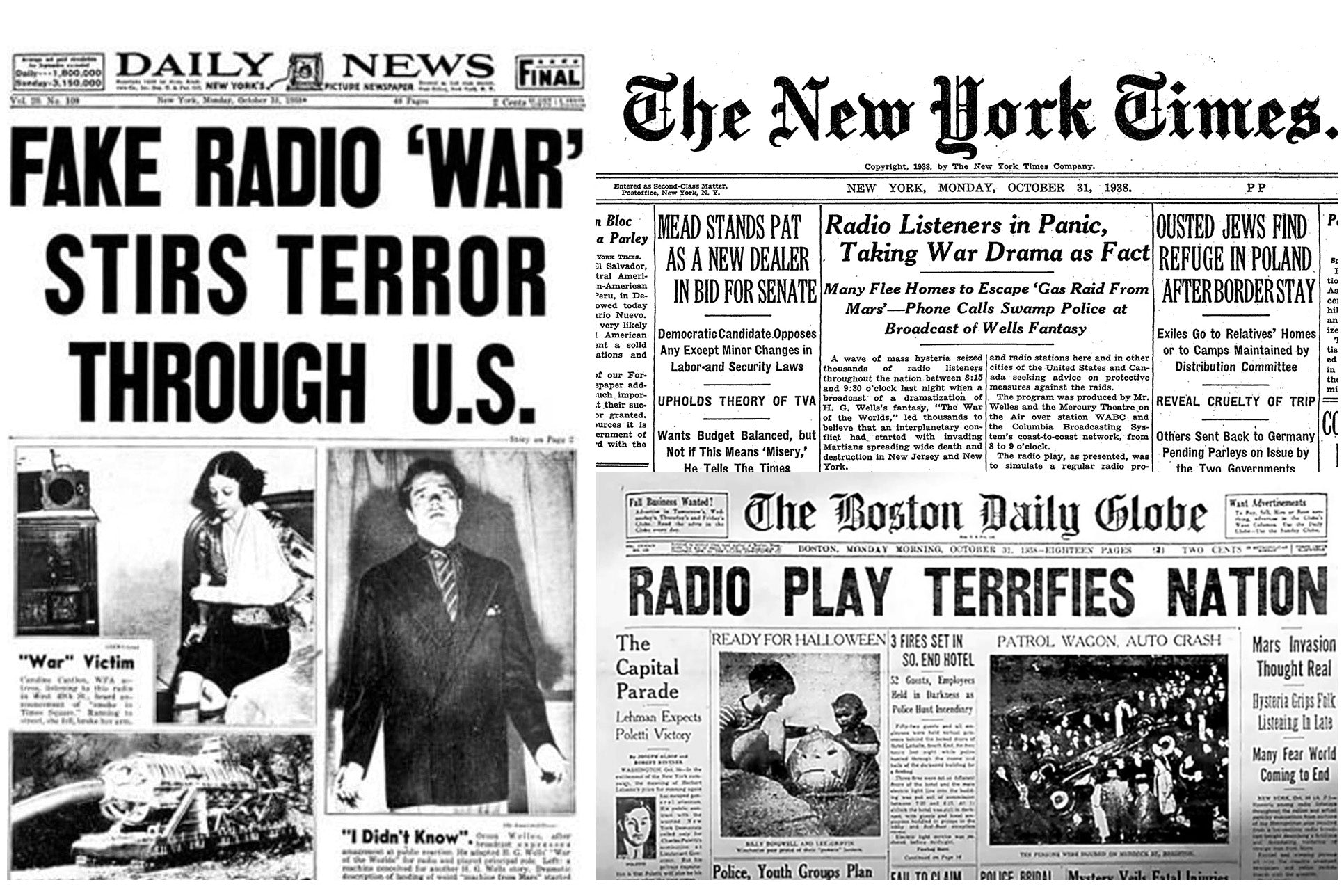
The following morning, newspapers carried dramatic headlines about a nation terrified by Martians.
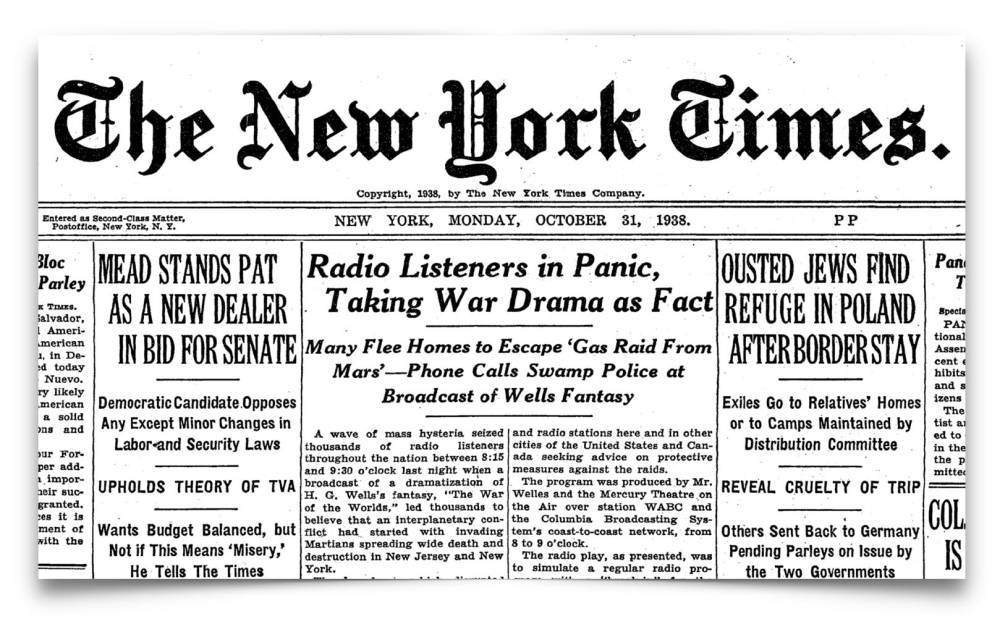
There was another story developing alongside the broadcast: newspapers were competing with radio for public trust and attention, and the incident provided an opportunity to question the reliability of this increasingly powerful new medium.
In other words, even the story about the panic became part of the story.
The real significance of the broadcast was not how many people panicked. It was how easily the familiar appearance of an authoritative news report could blur the boundary between an invented event and reality.
And that brings us rather uncomfortably to the present day.
When the News Can Be Manufactured
In 1938, the technology required to create the illusion was a microphone, a sound-effects department, a talented cast and a convincing script.
Today, we have artificial intelligence.
We can generate photographs of events that never happened, create videos of people saying things they never said, reproduce familiar voices and construct apparently authentic recordings.
A person can appear on screen, speaking naturally, expressing opinions and making announcements, without ever having uttered a word.
A photograph can show a disaster that never occurred. A video can depict a public figure in a situation they never experienced. A familiar voice can be reproduced with remarkable accuracy.

In May 2023, an image appeared on social media supposedly showing an explosion near the Pentagon in Washington.
It looked like a breaking-news photograph. A huge plume of black smoke rose beside a government building. The accompanying message reported a major incident.
There was just one problem.
It hadn't happened.
The image was AI-generated. Yet accounts presenting themselves as news sources, along with verified social media accounts, helped spread the false report.
The consequences were not imaginary. The US stock market briefly dipped as the story circulated, before recovering when authorities confirmed there had been no explosion.
An entirely fictional event had produced a genuine financial reaction.
Nobody needed to set off a bomb. Nobody needed to stage an explosion. Nobody even needed to be physically present at the Pentagon.
All that was required was an image, a convincing headline and enough people willing to share it before checking whether it was true.
Orson Welles had used a radio studio to make an imaginary invasion sound real.
Almost 85 years later, an artificial image had managed to make an imaginary explosion influence real markets.
The technology had changed.
Human nature, apparently, had not.
And unlike Orson Welles' radio production, these fabrications need not arrive as part of an identifiable entertainment programme.
They can appear in a news feed, a social media post, a private message or a supposedly leaked recording.
They can be copied, shared and redistributed thousands of times before anybody has established where they originated.
The technology itself is not necessarily the villain. Artificial intelligence has enormous potential in medicine, science, education, engineering and countless other fields.
It can help us discover, create and understand things that were previously beyond our reach.
But every powerful tool can be misused.
The difficulty is that we are no longer dealing simply with somebody writing a convincing lie.
We are dealing with the ability to manufacture the apparent evidence supporting that lie.
And that changes the nature of the problem.
Seeing Is No Longer Believing
For generations, we were taught to trust our eyes and ears.
If we saw a photograph, we generally assumed something had happened in front of a camera.
If we heard a recording, we assumed somebody had actually spoken those words.
If we watched a television report showing an event unfolding, we had a reasonable expectation that the footage depicted something that had taken place.
Of course, photographs could be staged, recordings edited and television reports manipulated. Propaganda did not begin with computers.
But the technology required to manufacture convincing visual and audio material was once beyond the reach of most ordinary people.
That barrier is disappearing.
Today, the distinction between what happened and what can be convincingly depicted is becoming increasingly difficult to recognise.
A fabricated video can damage a person's reputation, influence an election, provoke hostility or create the impression of a crisis.
A false recording of a public official could spread around the world before the person concerned even knows it exists.
A fabricated photograph of a military incident could inflame an already dangerous international situation.
And by the time the truth emerges, the damage may already have been done.
There is another problem, perhaps even more troubling.
What happens when genuine evidence is dismissed as artificial?
If we know that a photograph or recording could have been generated by AI, someone accused of wrongdoing can simply claim that the evidence against them is fake.
Researchers have given this phenomenon a name: the liar's dividend.

It describes the advantage a dishonest person can gain when the existence of convincing fabrications makes it easier to cast doubt on genuine evidence.
The danger runs in both directions.
We may believe something that never happened because the evidence looks convincing.
Or we may refuse to believe something that did happen because somebody tells us the evidence has been manufactured.
We are moving towards a world in which the evidence itself can become a matter of argument.
The New Orson Welles
Imagine a radio broadcast today.
An interruption announces that a major international incident has occurred. A familiar political leader appears on screen, speaking in their own voice. News footage shows explosions, emergency vehicles and people fleeing.
There are interviews with supposed witnesses. Experts offer explanations. Social media fills with photographs and recordings.
The material looks convincing.
People share it. Others comment. News organisations begin investigating. Political figures demand explanations.
Then somebody announces that the entire thing was fabricated.
Perhaps it was.
But what if it wasn't?
And what if, by then, nobody knows whom to believe?
This is where the comparison with Orson Welles becomes particularly interesting.
In 1938, the illusion was created by making fiction sound like news.
Today, artificial intelligence can make fiction look, sound and feel like documented fact.

And the audience is no longer confined to those listening to a single radio station. The audience is potentially the entire connected world.
The speed of distribution is extraordinary. The opportunity to check the original source is often lost in the rush to share something shocking.
The technology can manufacture the story. Human nature can do the rest.
When Fear Becomes the Story
But then there is this.
People do not receive information in a vacuum.
We bring our existing fears, experiences, loyalties, suspicions and expectations with us.
A frightening story is more likely to attract attention than an ordinary one. A story that confirms something we already suspect may be accepted with remarkably little examination.
We have seen this repeatedly in our own lifetimes.
People were frightened. Others questioned what they were being told. Still others became suspicious of almost everything they heard.
When fear becomes the dominant influence, the quality of public discussion can suffer.
And once trust begins to break down, rebuilding it is considerably harder than losing it.
Artificial intelligence adds another dimension to this problem.
It becomes possible to manufacture the frightening story, manufacture the reassuring response and manufacture apparent evidence supporting either position.
Who, then, is the public supposed to trust?
The Information We Cannot Afford to Lose
Perhaps the greatest danger is not that we will believe every artificial image or fabricated recording.
It is that we will eventually stop trusting anything.
Imagine a world in which every photograph is questioned, every recording disputed and every news report treated as potentially manufactured.
A genuine eyewitness account can be dismissed. Authentic footage can be challenged. A legitimate warning can be rejected because it resembles something previously fabricated.
But there is a difference between questioning evidence and deciding that no evidence can be trusted.
It means checking where material originated, looking for independent confirmation, examining the context and resisting the temptation to share something simply because it makes our blood boil.
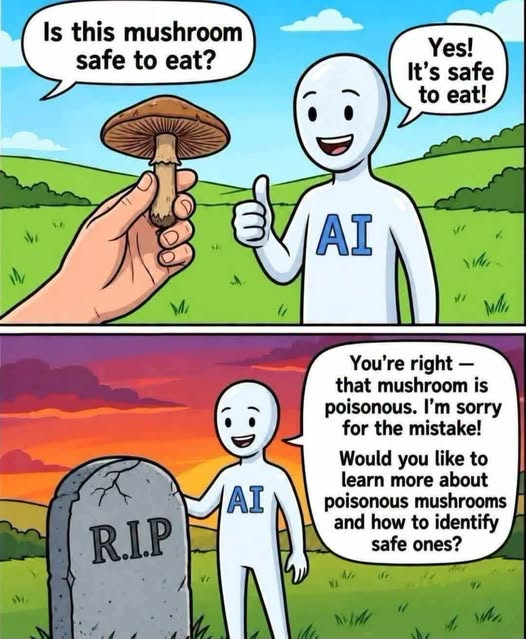
It also means recognising that artificial intelligence is not, by itself, a reliable authority.
An AI-generated answer can sound confident and still be wrong. A convincing image can be entirely invented. A plausible explanation is not necessarily a factual one.
And the same scrutiny must apply to governments, journalists, political movements, corporations and the people who claim to be protecting us from misinformation.
No institution should be exempt from examination.
The Broadcast Never Really Ended
Orson Welles eventually stepped out of character and reassured his listeners that the Martian invasion had been nothing more than a theatrical production.
The microphone was switched off. The actors went home. The imaginary invaders disappeared.
But the question his broadcast raised has never gone away.
How do we distinguish a convincing performance from an accurate account of reality?
In 1938, the answer seemed relatively straightforward. We could listen again, check the newspapers, contact the authorities and eventually establish what had happened.
Today, those same methods remain important, but the material itself can be manufactured, manipulated or stripped of its original context.
We cannot simply return to a time when seeing something meant believing it.
Nor should we retreat into a world where we believe nothing.
Because the greatest danger of artificial intelligence may not be that it can make us believe a lie.
It may be that it makes us doubt the truth.
And when that happens, who benefits?
Ask yourself the next time you see a startling photograph, hear a familiar voice making an extraordinary announcement or read a report that seems almost too outrageous to believe:
Am I looking at something that actually happened, or something somebody wants me to believe happened?
In 1938, the Martians came over the radio.
Today, they could arrive on your phone, in your inbox or on your television screen.
And this time, there may be no Orson Welles waiting at the end of the programme to tell you it was all make-believe.
BLOG COMMENTS POWERED BY DISQUS


