

King Haakon VII of Norway (1872–1957) was one of Norway’s most respected and beloved monarchs. Born as Prince Carl of Denmark, he was invited to become Norway’s king in 1905 after the country peacefully separated from Sweden. His strong leadership and resistance during World War II made him a symbol of national unity and defiance against Nazi occupation.
Throughout history, nations have either triumphed or been crushed in the face of authoritarianism, and so often it comes down to the strength of the people leading them.
But strength exercised through fear and strength exercised through patriotism and love are two very different things.
Hitler was strong. Pol Pot was strong. Idi Amin was strong. Fear can be a very effective tool of power.
But there is another kind of strength entirely ... the kind that asks ordinary people not to cower, but to stand.
And when it takes courage simply to defend your rights, your traditions, your history, or even your right to speak openly, chances are fear has already entered the room.
It is always our choice whether we stand or fall in the face of it.
I watched a movie some time ago - The King’s Choice from Norway. If you have not seen it, I urge you to find it and watch it.
More recently, I watched Number 24 on Netflix, another remarkable Norwegian story from the occupation years. What struck me in both films was not grand speeches or battlefield heroics, but the quiet, grinding courage of ordinary people forced to decide whether fear would govern their lives.
Norway entered the conflict of WW2 as a neutral country. It sought not to be for or against. It hoped it could stay out of the conflict and avoid the torment of the war beginning to rage around its borders.
Within a very short period of time, Norway learned that taking no side is impossible once you yourself are placed in the firing line.
Neutrality becomes impossible when fear, power, and control enter the fray.
In 1940, King Haakon was faced with one of the greatest decisions of his life. He was nearly 70 years old and fiercely patriotic. The German war machine was heavily dependent on iron ore from Sweden, much of it transported through Norway to ports servicing Germany’s industrial needs. Control of the Norwegian coastline also offered enormous strategic value to Germany in the North Atlantic.
A British expeditionary force landed in northern Norway but was eventually overwhelmed and evacuated from Narvik near the Arctic Circle. At the same time, the Norwegian royal family escaped aboard HMS Cossack and eventually made their way to London, where they remained throughout the war as a vital symbol of Norwegian resistance.
The value of Norway’s coastline and waterways would later become famous through stories surrounding the Tirpitz, the Altmark, and the desperate naval struggle in northern waters.

The demeaning expression “quisling” comes directly from Vidkun Quisling, the German-installed Norwegian collaborator whose name became synonymous with betrayal itself – not a leader, but a puppet.
Denmark capitulated within hours of German invasion after being effectively told that surrender would spare Copenhagen from destruction.
Norway did not.
And much of that came down to one man making a choice.
Hitler wanted to install a Nazi-friendly government in Norway under Quisling, someone the Norwegian people neither liked nor trusted. Despite enormous pressure, King Haakon refused to legitimise the occupation or abdicate.
The strength it must have taken for this ageing King to stand against Nazi Germany is astonishing. His fear must surely have been immense. But his love for his nation and his people proved greater than his fear of death or uncertainty.
He chose to stand rather than crawl.
The Germans retaliated with bombing campaigns.
The ruins of Molde after the bombing in 1940.
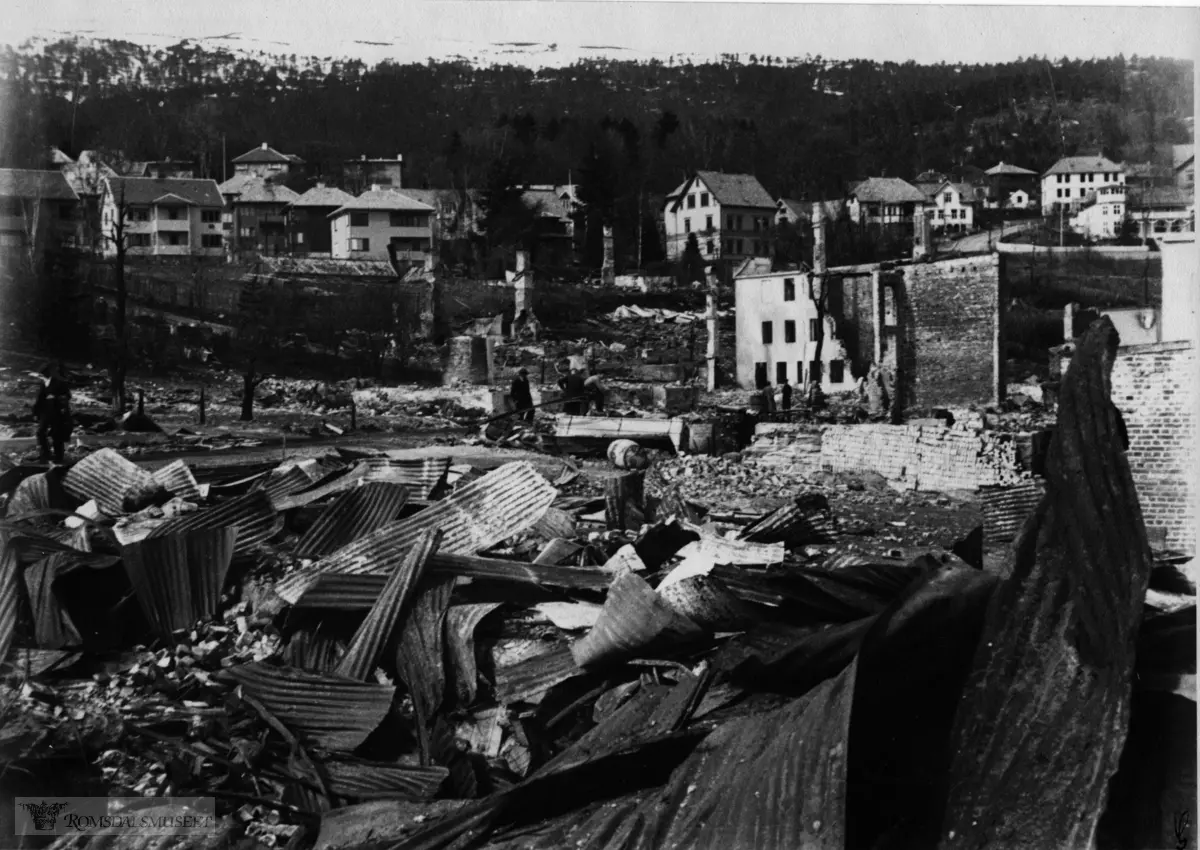
It became known to German forces that the King, the Crown Prince, and members of the Norwegian government were sheltering in Molde alongside large British and French forces. German aircraft were dispatched not merely to capture the King, but to kill him.
On 28 April 1940, Molde was bombed heavily.
Only seconds of warning were given before the attack began. King Haakon and Crown Prince Olav fled into wooded areas outside the town, where the famous photograph beneath the “Kongebjørka” - the King’s Birch Tree – was taken during the bombardment.
King Haakon ultimately escaped Norway with government leaders and formed a government-in-exile in London.
During the occupation, the King regularly addressed his people through BBC radio broadcasts.
Each Christmas, his voice reached occupied Norway. Those broadcasts became lifelines of morale and national identity. They reminded Norwegians that their King had not surrendered, even if their country had been occupied.
Everywhere in Norway during the occupation from 1940 to 1945, the King’s monogram “H7” became a forbidden symbol of freedom. Simply drawing it on walls or roads could lead to imprisonment.

Watching Number 24, one is reminded that resistance was not always dramatic acts of sabotage or gunfire. Often it was quieter than that. Ordinary people refusing to surrender their conscience. Citizens refusing to let fear dictate who they were.
From 1942 to 1945, Quisling formally headed the collaborationist Norwegian government under German control. His regime assisted Nazi policies, including the deportation of Jews to concentration camps in occupied Poland.
After the war, Quisling was tried for treason and executed by firing squad at Akershus Fortress in Oslo on 24 October 1945.
Germany capitulated on 8 May 1945. Crown Prince Olav and government ministers returned days later to a liberated Norway. King Haakon himself returned on 7 June - exactly five years after he had been forced to flee.
Make no mistake, we are once again living through a time of uncertainty and pressure throughout much of the world.
Authoritarianism does not always arrive wearing jackboots. Sometimes it arrives through intimidation, ridicule, censorship, social pressure, or the slow teaching of national shame.
And history shows that once fear becomes the dominant force in public life, freedom begins to retreat remarkably quickly.
Now is the time for strength, not weakness. Now is the time for patriotism, not self-loathing. Now is the time to stand upright rather than quietly submit to being shouted down or intimidated into silence.
Because if we willingly lie down, we should not be surprised when we are eventually walked over.
In the end, Norway’s greatest weapon was not a battleship or an army.
It was an old King who simply refused to crawl.
History tends to remember men like that.
BLOG COMMENTS POWERED BY DISQUS


