

Yesterday we remembered a simpler time.
No tracking apps. No panic buttons. No government campaigns.
Just one quiet rule whispered before you left the house:
“Don’t go with anyone unless they know the password.” In our house, it was Tripitaka.
A strange word for a child, but a powerful one. It wasn’t about fear - it was about judgment. About knowing that trust is not freely given… it is tested.
And that lesson doesn’t stop at the school gate.
Because in the corridors of power, the stakes are the same - only the consequences are far greater.
Leaders don’t fall because of strangers.
They fall because they gave the password to the wrong people.
History is littered with leaders who promised stability and delivered scandal. Not always through their own hand, but through the people they chose to trust. In politics, character matters - but judgment matters more. Because the company a leader keeps will ultimately define how they are remembered.
Two striking examples are U.S. President Warren G. Harding and Queensland Premier Sir Joh Bjelke-Petersen. Different nations, different eras - but the same fatal flaw: misplaced trust.
When Harding became President in 1921, he promised a “return to normalcy” after World War I. He was widely liked - approachable, steady, and pro-business. But his presidency became synonymous with corruption, not because of what he did, but because of who he allowed close to power.
The Teapot Dome scandal revealed that his Secretary of the Interior, Albert Fall, had secretly leased federal oil reserves to private companies in exchange for bribes. Harding himself was never proven to be directly involved. It didn’t matter. His administration became defined by the scandal, and his legacy never recovered.
Harding wasn’t remembered for what he built - but for who he trusted.
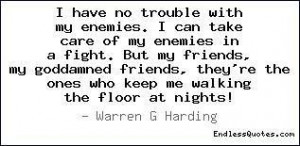
Meanwhile, in Queensland…
For nearly two decades, Sir Joh Bjelke-Petersen dominated Queensland politics. He championed development, projected strength, and built a loyal following. Under his leadership, the state grew - but so too did the concentration of power.
The Fitzgerald Inquiry later exposed deep and systemic corruption within the police force and political system. Bribery, protection rackets, and collusion with criminal networks had taken root. While Bjelke-Petersen denied direct involvement, his government had created the conditions for corruption to thrive.
Like Harding, he was not ultimately judged by his achievements - but by the company he kept and the culture that grew around him.
Different continents. Same lesson.
- Cronyism corrodes: Loyal insiders, left unchecked, become liabilities.
- Trust erodes quickly: Once the public loses faith, it rarely returns.
- Achievements fade: Scandal becomes the headline history remembers.
- Institutions suffer: The damage extends far beyond one leader.
And if that were the end of the story, it might be comforting. A warning from the past. A problem corrected.
But it isn’t.
After the Fitzgerald reforms, the Goss government came to power promising transparency and accountability. Yet the Heiner Affair soon cast a long and troubling shadow.
An inquiry into a youth detention centre was abruptly shut down. Documents were shredded. The justification was legal risk. The suspicion was something far more serious.
Critics argued that evidence - potentially including allegations of abuse - had been destroyed. No prosecutions followed. No full reckoning came. But the damage was done.
The message to the public was unmistakable:
It wasn’t just one side of politics. It was the system itself.
The Heiner Affair became a symbol - not just of alleged wrongdoing, but of something deeper: the instinct for self-preservation inside government, regardless of who holds power.
Even decades later, it lingers. Not because of what was proven - but because of what was never fully resolved.
And that is the most corrosive outcome of all: uncertainty.
Because when people begin to believe that truth can be buried, documents destroyed, and accountability avoided, trust doesn’t just weaken - it collapses.
The names and parties may change. The pattern does not.
Which brings us back to the simplest lesson of all.
The danger was never the stranger at the door.

It was the moment you opened it.
Because once the wrong person knows the password… it doesn’t matter how strong the house is.
And in 2026, there is one final truth our leaders would do well to remember:
You can delete a post.
You can bury a file.
You can run an inquiry.
But you can never unring the moment you trusted the wrong person.
And history ... unlike a shredder .... keeps everything.
BLOG COMMENTS POWERED BY DISQUS


