

A Caribbean blackout reveals the quiet power of China’s global infrastructure strategy.
On March 4th, Cuba’s national electricity grid collapsed. The failure began at the Antonio Guiteras thermoelectric plant - the largest power station on the island. A boiler leak forced the plant offline, and within hours the outage cascaded through an already fragile system.
Flights were grounded. Food spoiled in refrigerators. Families sat in dark apartments waiting for power that did not return for many hours. For a country already enduring blackouts lasting ten to twenty hours a day, it was another brutal reminder that Cuba’s energy system is hanging by a thread.
But the story of Cuba’s blackout did not begin this month. Back in 2018 we ran an article that raised more than a few eyebrows.
It suggested that China’s grand “New Silk Road” - the Belt and Road Initiative - was not simply about trade. Beneath the language of cooperation, infrastructure and global development might lie something deeper: a quiet strategy of influence built not with armies, but with ports, railways, loans and power stations.
At the time it sounded dramatic to some readers. Trade routes taking over the world? Surely that was stretching things a bit. Yet here we are in 2026 watching events unfold in real time - and suddenly that warning does not seem quite so far-fetched.
Because when Cuba’s lights go out, someone else has to bring the power. And increasingly, that someone is China.

excerpt from the 2018 article
The Cuban government blamed the United States.
And, to be fair, there is some truth in that accusation.
For decades Cuba relied on subsidised oil shipments from Venezuela. But the geopolitical winds have shifted. American pressure on Caracas and shipping networks has choked off much of that energy lifeline. Fuel deliveries have dwindled. Power plants designed in the Soviet era struggle to run without the oil they need.
Washington’s strategy is clear enough.
Maximum pressure without boots on the ground.
Squeeze the economy, restrict energy supplies, tighten sanctions and wait for the regime to crack under its own weight.
But while the United States tightens the screws, another global player has quietly been stepping into the gap.
China.

And this is where the story circles back to that warning from 2018.
China’s Belt and Road Initiative - often called the New Silk Road - stretches across continents. Railways link inland Chinese cities with Europe. Ports are expanding across the Indian Ocean and the Mediterranean. Highways, pipelines, telecommunications networks and energy projects now reach into more than a hundred countries.
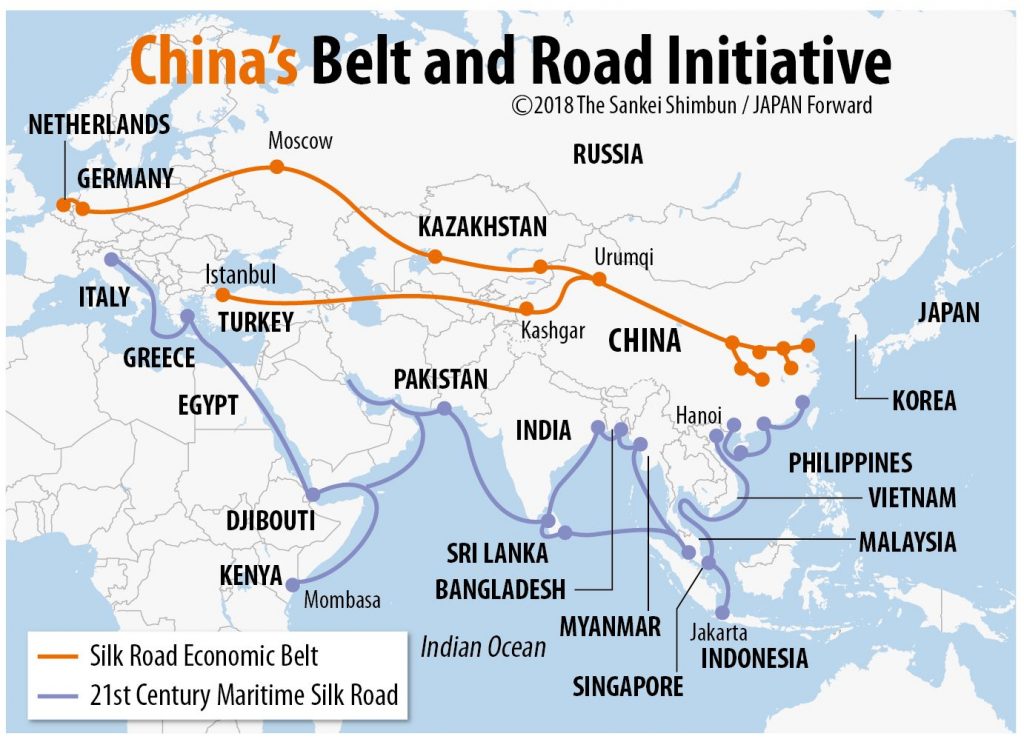
To its supporters it is a grand development project - a web of infrastructure connecting emerging economies to global trade.
To its critics it is something else entirely.
A slow-building network of influence.
Where the United States historically offered allies a security umbrella backed by fleets and military bases, China has chosen a different path. Instead of aircraft carriers and alliances, Beijing offers something far less dramatic but potentially just as powerful.

Connectivity.
Ports instead of warships.
Railways instead of military treaties.
Power stations instead of air bases.
The logic is simple. If a country’s infrastructure is financed by Chinese banks, built by Chinese companies and maintained with Chinese technology, the relationship that follows is no longer just commercial.
It becomes structural. Dependency grows quietly. Influence follows.
That is why analysts sometimes refer to the Belt and Road strategy as a system of bridges. China builds bridges where others once built fortresses.
In Cuba those bridges are now appearing in the form of renewable energy infrastructure. Solar power projects have expanded rapidly across the island, with dozens of new solar parks appearing in recent years. Chinese financing and equipment are helping Havana diversify its energy sources at a time when imported fuel is increasingly scarce.
The capacity is still modest compared with Cuba’s total needs. But it is enough to keep the lights flickering.
Enough to prevent collapse. Enough to ensure that Havana has options beyond Washington’s economic chokehold.
What we are witnessing is not simply an energy crisis on a Caribbean island. It is a small window into a much larger geopolitical contest.
On one side stands the United States, using sanctions, tariffs and financial pressure to weaken regimes it considers hostile.
On the other stands China, extending trade routes, infrastructure projects and development loans that draw countries into its economic orbit.

Neither approach is new.
But rarely have the two strategies collided so directly.
For ordinary Cubans the result is brutal hardship - long nights without electricity, empty shelves, ration books and uncertainty about tomorrow.
For the strategists watching from Washington, Beijing and beyond, the implications are far larger.
Because Cuba is not just another struggling economy.
It sits barely ninety miles from Florida.
Meanwhile, far from the Caribbean, similar patterns are unfolding in other corners of the world - including our own backyard.
Across the South Pacific, small island nations have been receiving Chinese investment in ports, roads and communications infrastructure. Australia, the United States and their partners have begun responding with their own development programmes, wary of losing influence in what has traditionally been their strategic neighbourhood.
The competition is quiet. But it is unmistakably real. Some observers have begun calling it an economic Cold War - a contest fought not with tanks and missiles, but with supply chains, investment funds and infrastructure projects.
Looking back now, the warning raised in 2018 does not feel quite so dramatic.
China is not conquering the world with armies. It is connecting it with bridges. And bridges, once built, are very hard to dismantle.
For those of us watching from Australia and the wider Pacific, the lesson is clear. Trade is never just trade. Sometimes it is strategy. Sometimes it is leverage.
And sometimes .... as the lights going out in Cuba remind us ..... it is the slow architecture of power quietly reshaping the world.
BLOG COMMENTS POWERED BY DISQUS


